 By sealing all the air leaks in your home’s envelope while temperatures are still mild, you’ll improve your home’s energy efficiency year round. Whether you do the project yourself or hire a professional, it’s one of the best low-cost home improvements with a high payback.
Finding the Leaks
The fastest and most precise way to identify the leakage throughout your home’s envelope is to have an energy audit. Licensed auditors use a blower door, which is a large fan that sits inside an adjustable frame that fits inside an exterior door frame. Once your home is ready, the auditors turn the fan on and it pulls the air out.
The gauges on the blower door frame indicate how fast and far the air pressure indoors falls. If your home is tight, pressure will fall quickly. A leaky home will lose pressure slowly because the fan pulls air inside from the cracks and gaps in the shell.
Identifying the leaks on your own is possible through a visual inspection or by pressure testing your home by:
- Closing all exterior doors and windows.
- Turning on the kitchen and bathroom fans.
- Lighting a candle or incense stick.
- Slowly walking through the home, identifying where the smoke or flame wavers to find the air leaks.
Most leaks occur around window and exterior door frames, recessed lights, pipe and cable entry points, and flues and vent stacks.
Sealing the Leaks
These products are manufactured specifically to seal leaks:
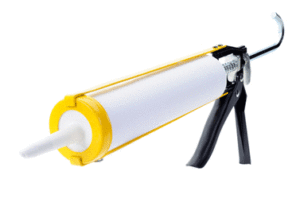
- Acrylic caulk — Use around window frames and small cracks in the exterior.
- Weather stripping — Apply to exterior door frames. Use special weather stripping for windows.
- Draft blockers — Place at the base of exterior doors that leak from the bottom.
- Expanding foam — Fill larger gaps with expanding foam. Use electrical or fire-rated foams around entry points for wires or vent pipes.
- Metal flashing and silicone caulk — Place around chimneys or flues.
If you suspect that air leaks are increasing your heating and cooling bills, sealing them is productive and worthwhile. To learn more, contact CCAC, providing HVAC services for homeowners throughout the Coastal Bend area.
Our goal is to help educate our customers in Corpus Christi, Texas about energy and home comfort issues (specific to HVAC systems). For more information about other HVAC topics, download our free Home Comfort Guide or call us at 361-678-2495.
Credit/Copyright Attribution: “Norman Pogson/Shutterstock”

Helpful Information For You And Your Home

We Put Our Customers First
At Mathews CCAC, we understand the importance of having safe and reliable appliances and systems in your home. Our local experts understand the unique challenges and weather that Texas properties face. From indoor air quality testing to water leak repairs, we deliver the necessary services and knowledge to keep your systems functioning correctly and efficiently. Trust us with your HVAC, electrical, and plumbing needs and benefit from:

Trane Comfort Specialists

100% Satisfaction Guaranteed